Excursion to Soweto
Soweto, on excursion
I had been to South Africa before. Once as part of the SADC Parliamentary Forum’s Gender Equality, Women Advancement and Youth Development Committee, representing young people from Zimbabwe. Another time just passing through OR Tambo International Airport, connecting to somewhere else. But those visits were functional you see the inside of a conference room, you see a departure gate, you do not really see the country. The YALI excursion to Soweto was different. This was a proper tour, the kind that takes you to the places that made South Africa what it is, where the history is not in a textbook but in the ground beneath you.
Soweto short for South Western Townships was not just a neighbourhood. It was where the 1976 student uprising began, where schoolchildren marched against being taught in Afrikaans and where Hector Pieterson, a twelve-year-old boy, was shot and killed, his image becoming one of the most recognisable photographs of the apartheid era. The day that followed was declared the Day of the African Child, observed every year on 16 June across the continent. Soweto was also home to the only street in the world where two Nobel Peace Prize winners lived side by side: Nelson Mandela and Desmond Tutu, both on Vilakazi Street. It is the kind of place that does something to you if you let it.
But before any of that, there was the problem of the buses.
Two buses were taking us from the hotel to Soweto, and somehow I still do not know exactly how it happened Vanessa and I ended up on different ones. This was not the plan. The plan, as always, was to be wherever she was. A long ride to Soweto was exactly the kind of opportunity I had learned to recognise: time, proximity, music. It had worked before. But I had not thought to ask her, in the rush of boarding, whether we could take the same bus. And by the time I thought to check, she was already on the other one.
So there I was, on the bus without her, thinking about the bus with her. Who was she sitting next to? Was she listening to music? Was she bored? Had she noticed I wasn’t there? These are not the thoughts of a rational man, I know. But they were my thoughts, and I had a long ride to sit with them.
Eventually I decided to stop stressing and just be present. People who know me often call me a nerd I think introvert is more accurate, but I have learned that the distinction matters less than what you do with it. What I do with it, when the moment calls for it, is try to make people laugh. I can do that. I have always been able to do that.
I was seated near the front, and there was a microphone. Before I fully thought it through, I picked it up and became the pilot.
I had been looking up the places we were going to visit on my phone the Constitutional Court, the FNB Stadium, Vilakazi Street taking notes the way I always do. So I had the material. What I added was the voice. You know how pilots speak: that particular calm, the slight drawl, the way they announce turbulence as though they are commenting on the weather at a garden party.
“Good morning, ladies and gentlemen, and welcome aboard YALI Air, Flight Cohort 23, non-stop service from the hotel to the great township of Soweto. My name is Captain Godwil, and I will be your pilot today. We are currently cruising at a comfortable altitude of zero feet above sea level and are expected to encounter mild turbulence in the form of your own excitement. Please ensure your seatbelts are fastened, your laptops are at full power we do not want a repeat of the charger incident and your learning caps are securely on your heads. On behalf of YALI Air and the entire crew, we thank you for choosing us. You had no other option, but we appreciate the loyalty.”
Then, as we approached each destination, I would switch from the history on my phone into pilot mode: “Ladies and gentlemen, if you look to your left, you will observe the Constitutional Court of South Africa, established in 1994 following the country’s first democratic constitution and sitting atop Constitution Hill a site that was previously a prison, because this country has a sense of irony. The Court consists of eleven judges and protects the rights of every person on South African soil. The eternal flame outside the building has been burning since the court was opened and, unlike the connectivity in our hotel, has never gone out.”
The bus erupted. People were laughing, leaning over to their neighbours, asking where this man had come from. And I kept going every stop got an announcement. When we approached FNB Stadium, also known as Soccer City or The Calabash, I told them it was shaped like an African cooking pot and had held 94,736 people for the 2010 World Cup final, and that it was on this very ground that Nelson Mandela gave his first speech in Johannesburg after walking out of prison in 1990. I delivered this information in the same unruffled pilot cadence, as though we were experiencing light turbulence over the Atlantic. When the bus pulled away from a stop and I said nothing, people would start making the ting-tong aeroplane chime sound themselves, calling for the pilot. That was the moment I knew it had worked.
But even with the whole bus laughing, part of my mind was elsewhere. I kept thinking: she would have liked this. Not in a tragic way I was genuinely having fun. But there is a particular feeling when something good is happening and the one person you want to witness it is not in the room. I had spent three weeks engineering small moments between us, and here was a large one happening without her. I wondered if she was bored on her bus. I wondered if anyone over there was making her laugh.
The first stop was the Constitutional Court on Constitution Hill, where the driver for the other bus apparently took a different entrance, so the two groups arrived at separate gates. I did not find Vanessa immediately. We met inside eventually, but those first minutes of scanning a crowd looking for one specific person that is a particular kind of impatience I had become quite familiar with over the three weeks.
The court itself is worth the visit. It sits on the same ground as the Old Fort Prison, where both Mahatma Gandhi and Nelson Mandela were once held. The architects kept parts of the old prison walls deliberately, so you walk past what held people captive and into a building designed to set them free. Outside the main entrance there is a flame the Constitutional Court flame that has burned continuously since the building opened. The inscriptions on the walls are from the Constitution itself: dignity, equality, freedom. It is not a subtle place. It does not try to be.
While doing the tour, my mind never fully stopped tracking where she was. Not in a way that took away from the experience I absorbed what I was seeing, I was genuinely moved by some of it but she was a frequency I could not fully tune out.
The Zulu headdress came into the story around this point. I had known from the acceptance letter that graduation would require cultural dress, and being Ndebele with a surname that is Zulu, a father who traces roots to South Africa, and the ability to speak Zulu well enough to pass I did not bring anything from Zimbabwe. I would buy something here instead. The headdress I found is a traditional Zulu isichollo-style piece, made from cowhide with the hair still on it, shaped and hardened into a wide disc. It is not subtle either. You wear it and people know exactly where you come from, or at least where your name comes from. I had already been greeted as Mageba the Zulu royal totem by the woman handing out stipend cards on the first day, and spoken to in Zulu at the Mall of Africa by a woman who took one look at my passport and switched languages without asking. The headdress felt right.
When I bought it, Vanessa happened to have a carrier bag. I put the headdress inside without asking. She did not object. The plan was simple: I would “forget” to collect it, she would need to find me at the hotel to return it, and there would be a conversation. It was not the most sophisticated scheme I had run, but it was consistent with the overall strategy. The charger had taught me that the best pretexts are the ones that feel genuinely practical.
At Vilakazi Street, the mood shifted. This is where Hector Pieterson was shot in 1976, where the photograph was taken, where the child’s name became a date and the date became a continent’s annual reckoning with what was done to its young people. The tour guide sang songs there freedom songs, protest songs and I knew them. Growing up Ndebele in Zimbabwe, those songs were not foreign to me. The languages are close, the history connected, and some of those melodies were in my childhood before I knew what they meant. Standing there on Vilakazi Street, hearing them sung on the pavement where they were born, was something else entirely.
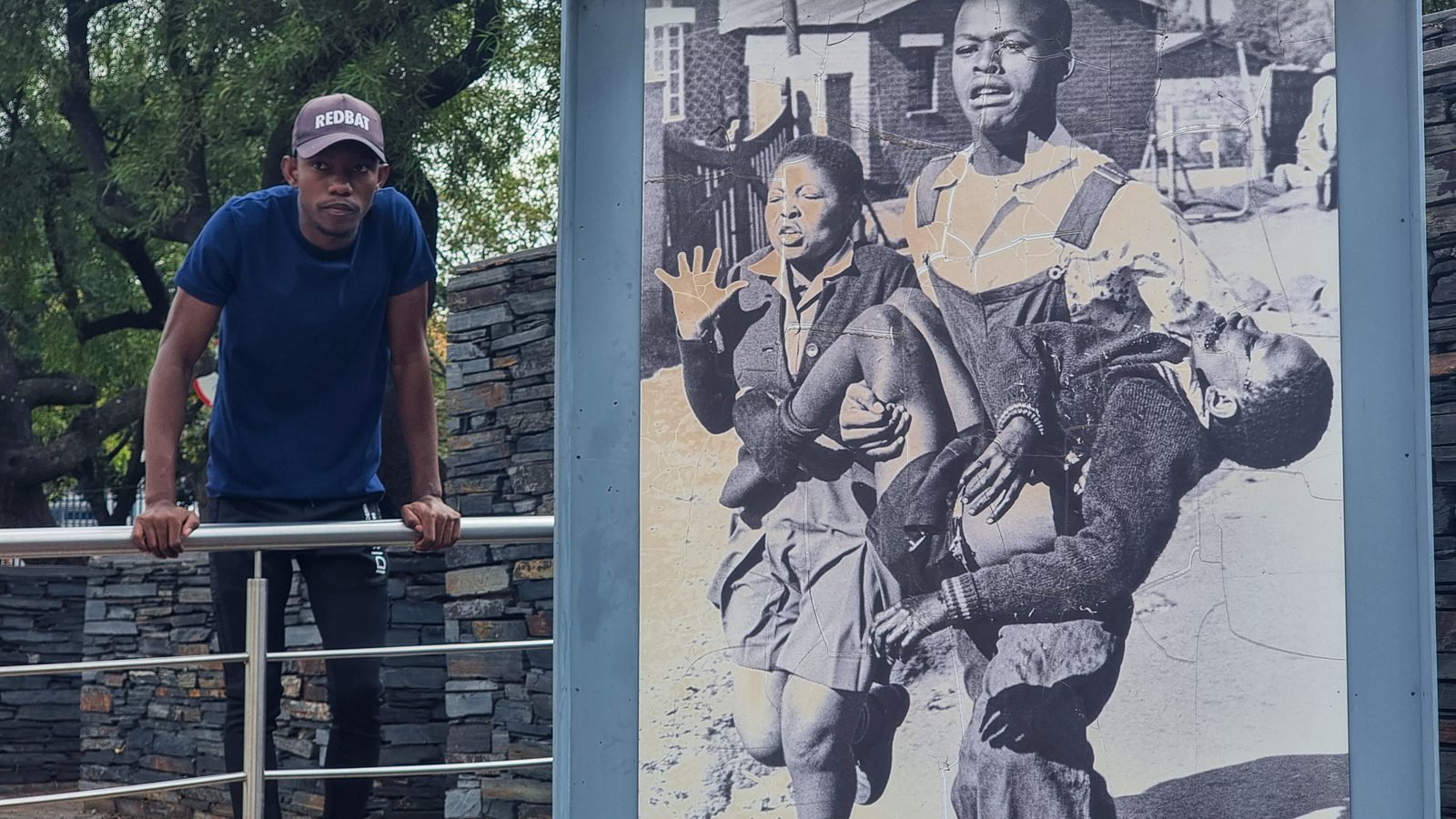
Beside the photograph itself, on Vilakazi Street — the image of Mbuyisa Makhubu carrying Hector Pieterson, Antoinette Sithole running alongside, that became the picture the world remembers 1976 by.
People began taking pictures. I saw Vanessa posing with her friends, and Denis who by this point had become something of a quiet ally in the ongoing project of getting me closer to Vanessa caught my eye and gestured. I walked over. Denis moved the camera, and Vanessa looked at me and said, come, let’s take a picture. What followed was a pose I had not encountered before: she wanted me to balance on her shoulder, right leg raised, like something between a dance move and a human sculpture. There was a lot of contact involved. I am not going to pretend I did not notice.
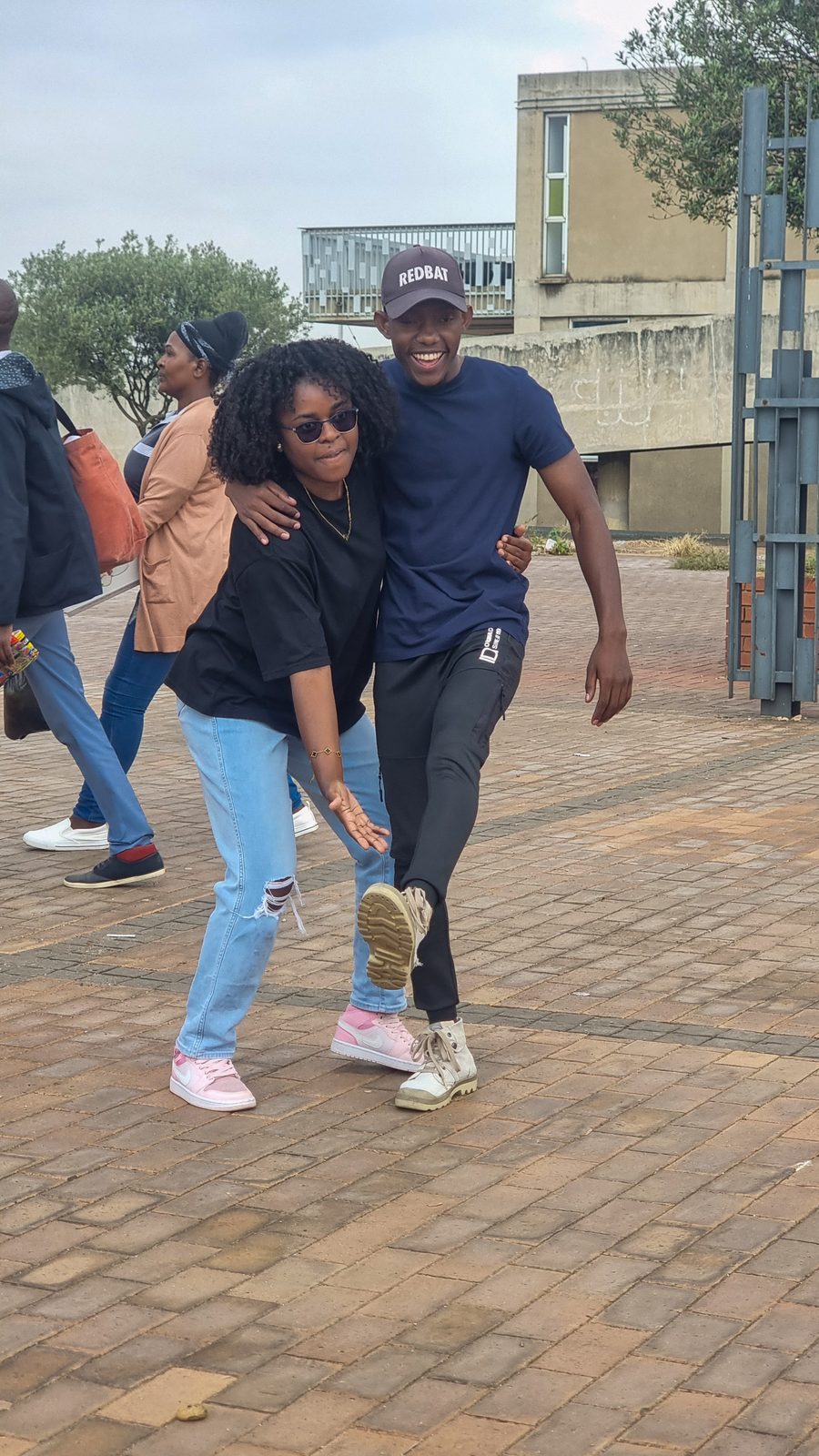
The pose itself — her hand steadying his balance, his leg mid-air, Vilakazi Street going on behind them like nothing unusual was happening.
She had told me weeks earlier that she had no interest in fostering false hope. And yet, here she was, engineering a pose that required her to hold my leg. I have looked at that picture many times since. I still do not know what to make of it. I just know that we laughed, and for that short stretch of Vilakazi Street, with the tour guide’s songs still in the air and the history pressing in from every direction, it was just the two of us finding something funny together. That is still one of the moments I come back to.
Then it was back to the buses. Back to the separate buses. The day was long, everyone was tired, and by the time we returned to the hotel there was not much left in anyone. We freshened up and rested. But I went to sleep thinking about the pose. And the songs. And the fact that she had held my leg without being asked.
The ending arrives by email first. Get each new chapter the morning it’s published — no noise, just the book.
In the margins
Leave a note in the margin — it goes to the author first, and the finest notes are published here beneath the chapter.